Guide · Treatments
Peeling: at home or in a studio?
Mechanical peels passed a German safety check, while strong acid products belong in professional hands. Here is how to choose, with sources.
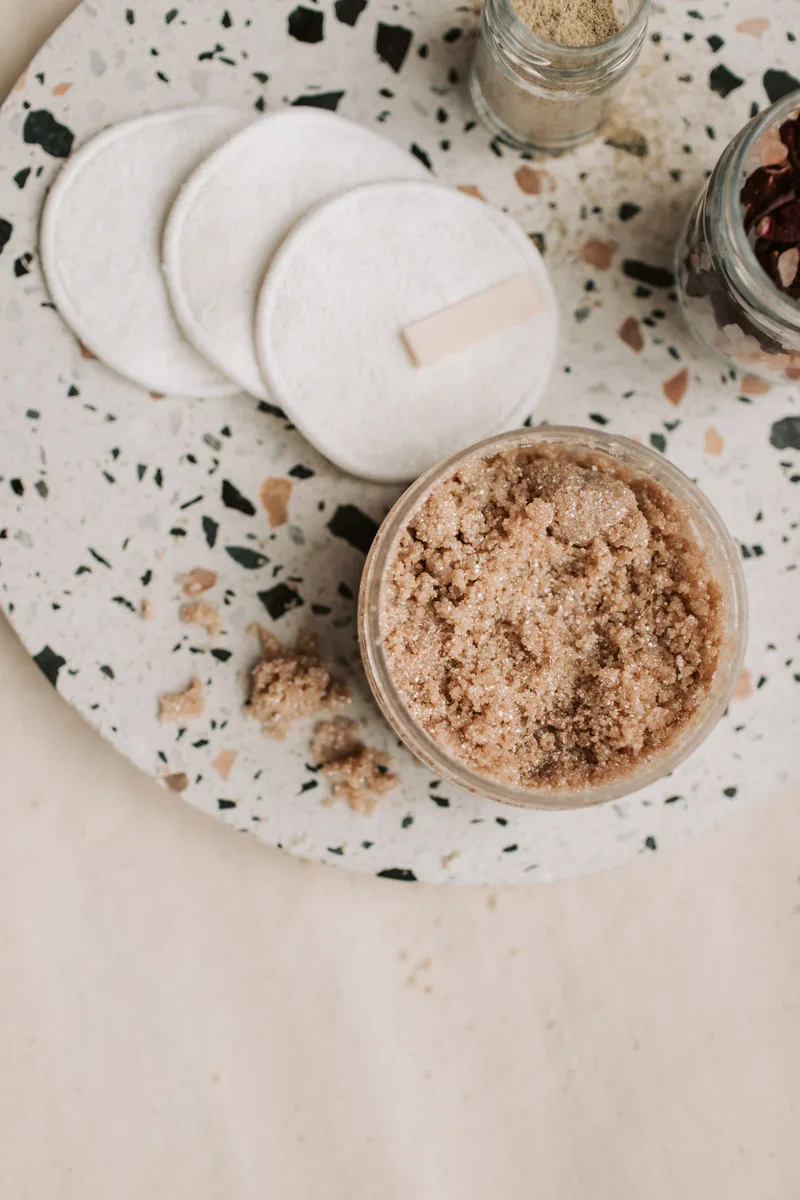
Short answer
In an investigation published by Stiftung Warentest, a German consumer organisation, the Chemical and Veterinary Investigation Office in Karlsruhe rated all 26 mechanical peels it tested as safe. Once or twice a week is enough, depending on skin type and skin condition. Peels with a high acid content are, according to Stiftung Warentest, a matter for dermatology practices or medical cosmeticians.
This guide follows the German article. It compares the options for everyday use and tells you where home care stops. It is not medical advice and makes no diagnoses.
What a peel is and which kinds exist
A peel is meant to loosen dead skin flakes from the surface. The term and its types are explained in the German glossary entry Peeling. Here is the short version:
- Mechanical peels loosen the flakes with fine particles that you rub in with light pressure.
- Acid peels are chemical peels and work with acids. Fruit acids (AHA) are explained in the German glossary entry Fruchtsäuren (AHA). Salicylic acid (BHA) is named separately.
- Enzyme peels are also chemical peels. According to Stiftung Warentest they are gentle and are said to suit sensitive skin as well.
The name matters less than the strength. The fruit acid peels criticised by Stiftung Warentest contained between 30 and 80 percent acid.
What the investigation found about peels for home use
According to Stiftung Warentest (16 September 2022), the Karlsruhe office examined 34 peeling products. It rated all 26 mechanical peels as safe. The organisation adds a limit: home use does not suit everyone, for example not people with active acne (see below).

How often is too often?
Stiftung Warentest writes that once or twice a week is enough, depending on skin type and skin condition, in addition to daily cleansing. If you overdo it, you can irritate your skin. Its advice for use: do it in the evening, massage gently and do not rub hard. For cosmetics in general, the Verbraucherzentrale (consumer advice centre) notes that less is often more for skin and hair.
Where home peels reach their limits
- Active acne: According to Stiftung Warentest, mechanical peels are not suitable for people with active acne, because inflammation can get worse.
- Strong acids: Of the eight products with fruit acids that were tested, the office rated six as not safe. They contained roughly 30 to 80 percent acid and mostly came from online shops. If left on for long, they can irritate the skin. Stiftung Warentest names chemical burns with scarring and pigment disorders as risks when they are used incorrectly. The main reason for the complaints was missing warning and usage notes, above all the note "for professional use only".
- Salicylic acid limit: According to Stiftung Warentest, salicylic acid may make up no more than two percent of the ready-to-use product in peels under the EU Cosmetics Regulation. The ingredients list on the pack, under the heading "Ingredients", shows which ingredients a product contains (Verbraucherzentrale).
- Irritated or diseased skin: If a rash or another unwanted reaction appears, the Verbraucherzentrale advises seeing a doctor.
What is different in a studio
Stiftung Warentest advises that peels with a high acid content should only be applied in dermatology practices or by medical cosmeticians. Afterwards, a neutralising solution and a UV blocker should be used without fail.
This is a guide, not a standard. If you are thinking about a studio, these questions help:
- Does the person first ask how your skin looks and what you have used so far?
- Do they explain what is applied, how long it stays on and what to do afterwards?
- Do they say something about sun protection after the treatment?
- Do they tell you when you should ask a doctor?
A cosmetic peel is not a medical treatment. Skin problems belong in a dermatology practice. In a studio you are free to ask about the training of the person who treats you.
AQAFACIAL™
There is a separate page on the AQAFACIAL™ treatment: AQAFACIAL™-Behandlungen (in German). The Hydrapeeling is a central step of the treatment: it dissolves dead skin cells with a gentle water flow and a peeling solution.
Sun after a peel
After a fruit acid peel, skin is more sensitive to UV radiation, according to Stiftung Warentest. It should therefore be protected from the sun consistently.
This fits the opinion of the EU scientific committee for cosmetics (SCCNFP), which it confirmed in 2004. As a precaution, it considered glycolic acid up to 4 percent at a pH of at least 3.8 and lactic acid up to 2.5 percent at a pH of at least 5.0 acceptable in cosmetic products. It recommended a note to avoid UV or protect the skin, because there were signs of a higher susceptibility to UV damage. The values date from 2004.
Tip from Luljeta Dine
Start rarely and mildly, and protect your skin consistently from the sun afterwards.
When to see a doctor
A peel is cosmetics, not a treatment for skin diseases. Stiftung Warentest names chemical burns with scarring and pigment disorders as risks of incorrect use, and the Verbraucherzentrale advises seeing a doctor for rashes. Have a doctor look at your skin if:
- it keeps burning, hurts, weeps or blisters after a peel,
- areas change colour for good or scars form,
- you have active acne, a rash or a known skin disease and are thinking about a peel.
You can find a dermatology practice through the specialist search of the German Dermatological Society.
Questions and answers
How often can I use a peel?
Stiftung Warentest names once or twice a week as enough. More often can irritate the skin.
Is a peel at home dangerous?
Mechanical peels were safe throughout in the investigation. For acid peels with a very high acid content that are sold without warnings, Stiftung Warentest warns of chemical burns. Read the usage and warning notes.
Do I need sun protection after a peel?
After a fruit acid peel, the skin is more sensitive to UV radiation, according to Stiftung Warentest, and should be protected consistently.
Which peel suits acne?
That cannot be said in general. According to Stiftung Warentest, mechanical peels are not suitable for active acne. Talk to a dermatology practice.
What does advertising promise for peels?
Stiftung Warentest writes that peels are meant to make skin smoother and boost cell renewal. The Verbraucherzentrale notes that cosmetics advertising often promises more than the product delivers.
By Luljeta Dine, Beauty Director at AQAFACIAL™, author and expert in cosmetics, wellness and well-being.
Read more
- Cosmetic treatments explained
- Skincare and cosmetics: guide
- Peeling: what is it? (German glossary)
- Fruit acids (AHA) (German glossary)
Sources
- Stiftung Warentest (test.de). Peelings: Zu viel Säure kann die Haut reizen (16.09.2022). https://www.test.de/Peelings-Zu-viel-Saeure-kann-die-Haut-reizen-5917226-0/. Retrieved on 11.11.2026.
- Wissenschaftlicher Ausschuss der EU für Kosmetika und Non-Food-Produkte (SCCNFP). Updated position paper concerning consumer safety of alpha-hydroxy acids, SCCNFP/0799/04, 2004. https://ec.europa.eu/health/archive/ph_risk/committees/sccp/documents/out284_en.pdf. Retrieved on 11.11.2026.
- Verbraucherzentrale. Kosmetik: Inhaltsstoffe, Kennzeichnung und unerwünschte Wirkungen. https://www.verbraucherzentrale.de/wissen/umwelt-haushalt/produkte/kosmetik-inhaltsstoffe-kennzeichnung-und-unerwuenschte-wirkungen-26338. Retrieved on 11.11.2026.
- Deutsche Dermatologische Gesellschaft e.V. Facharztsuche Dermatologie. https://derma.de/patienten/facharztsuche-dermatologie. Retrieved on 11.11.2026.
Updated 11.11.2026
Keep reading
Related
Topic
Skincare and cosmetics: guide
Cleansing, moisturiser, eye care and skin type: the basics of facial skincare, sorted by your questions and backed by sources.
Topic
Cosmetic treatments explained
What counts as a cosmetic treatment, and where does cosmetics end and medicine begin? This guide sorts it out, with a source next to every factual claim.